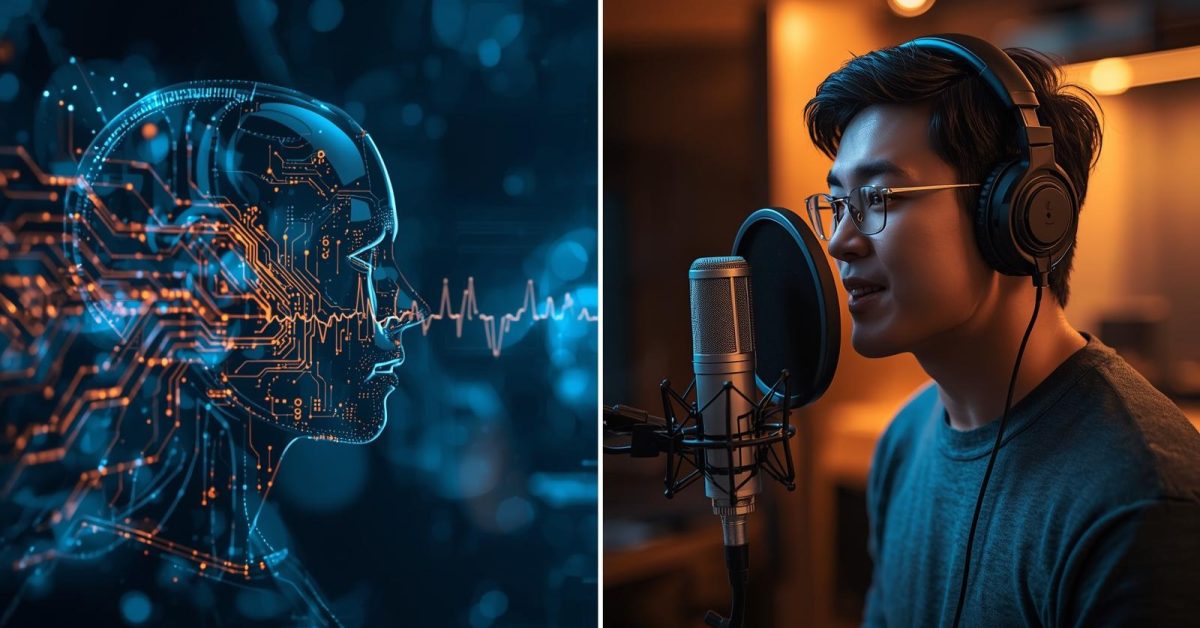
There is so much talk nowadays in the voice-over industry about “Can AI ever replace the raw human emotion of voice-overs? Is it really going to affect the entertainment and advertising industries badly?” Let’s see some major Differences between AI and human voice-overs, and this will help you understand what to look for when going for your next voice-over work. Some AI tools are becoming popular and doing some work effectively; however, we need to understand that these two things are different and they are used for different reasons.
What Are AI Voice-Overs?
An AI voice-over is an audio file generated with the help of mimetic speech tech, also called text-to-speech (TTS), generated from AI. These tools use machine learning algorithms and use natural language processing (NLP) and sound human-like. People have started using these AI voices now for some small projects, and not to forget, they cannot match human voice-over quality.
It is mostly used for automated messages across different industries, and it can be a cost-effective alternative for some businesses. This may be useful for companies that need high-volume audio processing and a short span of time. But we should keep in mind that you are getting the instant result at the cost of quality.
What Are Human Voice-Overs?
The voice over – that is where a real, live human puts their real, live voice into the script and tells you the story. The voice actors alone are what push the contents into a realm with imagination, emotion, truth (or at least it is what is given to voice actors). Their versatility and ability to line up, amalgamate a listenership of whatever they’re listening to. So the voice actors spend years, not to mention thousands of rupees, learning how to do things like pacing and tone and diction, and character.
They do audio, through their shell talent and skill in recording and sound engineering, which makes them sound smart and says more to the listener than a sound bite. And voice actors usually work in a closed team with the director and producers, and deliver final projects.
What are the Differences between AI and human voice-overs?
Emotional Touch
A good voice actor can add joy, sadness, anger, and a level of artistry that AI-based voices will struggle to do. Of course human voice will bring more engagement and excitement, and people will feel connected to the character more. They’ve gotten better, but a machine will never be able to fill a row with nuanced gestures in the slightest to feign some kind of emotion and be human about it. They can add sad, happy emotions, etc., in sound.
Customisation and Flexibility
AI voice-overs are very easy to use sometimes. We can customise speed, pitch, and tone as per our requirements. This improves the overall quality of how-to videos and explainer videos. Though Human voice-overs can take so much time but they sound real and hence people feel more connected with the message because of warmer and richer performances.
Cost and Time Advantage
AI voice-overs can be an alternative for low-budget projects. Once you are ready with recording equipment, it takes no time to record a project. This option can be suitable for businesses that look for instant production and for their small projects.
Hiring human voice-over actors can cost you a bit more sometimes because you need to hire a professional voice actor, a studio, and a sound engineer. And therefore, it will take more time to deliver the project. But if you invest in high-quality human voice-over services, it will leave a better impact on your brand. In many cases, it is indeed true that we’re paying for what we do get, that the upper reaches of the pricing structure are justified by the ability to articulate different kinds of emotions, and reach different kinds of audience.
Ability to Speak Different Languages and Accents
It can create multi-lingual and accents in one go, which is an important requirement for the AI voice-over tools. It can be useful for global brands that want to localise their message. The same message in a different language can be used to reach a wider audience.
Undoubtedly, human voice-over artists need more training time before they work on any project. North American, European, and Asian film production all have much higher costs to have multiple language versions with different voices. However, human actors convey a truthfulness and cross-cultural comprehension in their performances that AI cannot emulate. Nobody else can lay on that knowledge of culture and context and make it work for locals like you can.
It can be consistent.
The biggest quality of AI voice is the ability to deliver the same quality of sound consistently. After programming the voice, it will always broadcast in the same quality and tone, and this is a great advantage. This can be a great alternative for instant promotion for brand awareness.
Content ownership and Copyrights: Ethics and copyrights are another big concern over the AI vs human voice-over debate. Sometimes AI voices may sound nice, but they raise big concerns over content ownership and copyright. Who owns that AI voice, a company or a person? It’s a big question. Also, AI like able to instantly duplicate a human voice with proper isolation is a big concern too, of voice clones and how the deep fake tech is used.
When should you consider AI Voice Overs:
AI voice-overs can be ideal for businesses in automatically responding to a desk query and answering simple questions that can help improve the overall productivity of the business.
Affordable Applications:
AI voice-overs help small businesses to generate professional-quality work at a fraction of the cost.
Volume:
If the project has multiple versions or requires many changes, then AI can be used to match speed and scale.
When To Use Human Voice-Overs
High-Impact Storytelling: Films, audiobooks, and commercials lend themselves well to the naked emotion of human voices. Cultural Knowledge: Human actors know (and can react to) much more about human culture than AI. So whether it is the award ceremonies or some live event needs these human voice sessions as they have that versatility and that charm which a human voice can have.
Conclusion
AI Voice Over vs Human Voice Over — Who Wins? How do you do that, spend as little money and time as possible, without losing your sanity? AI voice-overs might have humans beat on size and homogeneity, but let’s not forget that real engagement and connection can be delivered by real men and women only. As the industry grows, we will see more experiments and changes in the days to come. After all, it’s not about AI vs human voice-overs —it’s more about creating a message, content, or an advertisement that can bring human connections.